Saturday, April 13, 2013

Amboseli: The Maasai and I


Well we’re back in Nairobi after a week in Amboseli.  We learned all about the Maasai and the current struggles they’re facing with maintaining their traditional culture. For those of you who aren’t familiar with the Maasai, just imagine your stereotypical image of an African warrior. Minimal clothing, long red shuka (blanket) wrapped around themselves, covered in beads, faces painted red, herding a bunch of cattle.  They’re the guys who greet you at Kenyatta International Airport dressed up in traditional garb even though they’re probably not even Maasai and were paid to stand there and pretend. Still confused? Hopefully this will help.

Making fire at the cultural manyatta (read below) 

We arrived on Sunday, March 31st to a beautiful tented resort outside Amboseli National Park. I’m sure the Real Housewives would have boasted to all of their socialite friends that they had spent a rough week camping had they stayed at our resort…but this was no camping. It was glamping! Whereas in Tanzania we slept in two person tents, took “bag-o-water” showers, and relieved ourselves in the woods, at this resort we slept in spacious areas complete with beds, a toilet, and a shower ALL INSIDE THE TENT! Call me Fergie, but this place was glamorous!

If only you could see the inside...it's better than Narnia 

We visited a cultural manyatta on our first day out in the field.  These “snapshots into traditional Maasai life” are ooh-ed and aah-ed over by tourists. Naive visitors come to these “villages” and think they’re getting an exclusive look at how Maasai people currently live.  However, locals view these villages more as business ventures than accurate representations of modern day living, and as well-informed students we were skeptical as well. We were greeted at the edge of the boma (enclosed village area) by beaming dancers draped in beads and traditional Maasai cloth. After having us join in on their extravagant welcome celebration, they brought us into the manyatta to teach us about their lifestyle.


A village medicine man taught us about herbal remedies used by the Maasai.  I had a strange feeling he was playing us when he picked up the same stick five times and each time described a very different purpose. It also didn’t help that he spoke perfect English when most Maasai that we met spoke Kimaasai, some Kiswahili, and very broken English.

"This herb heals eye sores" 
[put down stick, pick up identical stick]
"This herb cures heart disease" 
[put down stick, pick up identical stick]
"This herb will solve the nuclear missile crisis"

They also showed us the inside of their homes (i.e. huts). The entire house is approximately the size of my bedroom, and it includes a cooking area and two beds—one for the mother and all of the children, and one for the father. 

Ally, Chloe and I inside the hut

After completing our tour, they lured us over to their market area to buy handcrafted beads. Nothing like being heckled to buy crafts after experiencing the “true” Maasai way of life.

The rest of the week was filled mostly with interviews with local pastoralists, village elders and women, and farmers.  We also went on safari one morning in Amboseli National Park, but it appeared that the animals were all on holiday. By far the most exciting component was our one-night homestay with a real Maasai family.

My friend Abby and I spent the night with Grace, our translator, and her family.  She is one of 9 children and lives with her husband and two children in another boma down the road.  Grace is very well educated and she came back to her parents’ home for an overnight in order to translate our English into Kimaasai and vice versa. Luckily for us, she brought her 7-month-old son, Leonard with her!

Check out that smolder

Grace wanted to give us a true Maasai experience, so she showed us how to perform as many chores as she could fit into a 24-hour period.  We went to fetch water, which was about a 25-minute walk. We carried 5-liter jerrycans from our heads, and afterward my neck was sore for a day. Grace and her friend completely showed us up by carrying 20-liter cans! Grace helped me get over my embarrassment by assuring me that carrying the equivalent of a baby from one’s head is something that my neck has to get used to. Mothers take their daughters to fetch water as young as 5 years old. They start out carrying 3 liters and work their way up to 20 liters like their mothers.

Abby's a natural 


Other funtivities of the day included making traditional Maasai beaded jewelry with the women in our boma, milking our family’s goats, helping to cook meals, and smearing cow dung mixed with ashes on the houses to repair any holes.

Cooking with Grace 

Who needs cement when you can dunk your hands in cow poop? 


We spent the night in one of the houses with Grace. She shared her own bed with Leonard, and Abby and I shared a bed. Unfortunately we were in the cooking hut where a constant fire was maintained 24/7.  This wouldn’t have been too much of a problem (after all it was pretty cold once the sun set) except that there was NO ventilation in the huts. A tiny “window” the size of my hand was cut out of the wall near the fire pit, but it might as well have been covered by concrete. We convinced Grace to kill the fire, and Abby and I enjoyed our restless night of sleep on a bed of wood planks covered in cowhide.  The number of bed bugs, fleas, and ticks in our bed has yet to be determined. Rest assured Mom and Dad, all bugs have been removed from my body.

Kitchen (left) and bedroom (right)

Perhaps the best story I can share with you was of our first meal at the homestay. In February, when we were at our rural homestays in Meru, each of us had been stuffed to capacity and forced to eat enormous amounts of food. We had no choice but to choke it down because we didn’t want to be rude. And so, when Grace served both Abby and me an entire plate of potato and cabbage stew in addition to 8 brick-size pieces of ugali (bland, maize-meal wedges), I was under the assumption that I had to eat it all. There was no way I could finish the entire meal by taking my time, so instead I went with the Man v. Food approach.  If I’ve learned anything from Adam Richman, it’s that you have a 20-minute window to eat as much food as possible before your “food wall” goes up. After 20 minutes, your brain recognizes that your stomach is full and it’s nearly impossible to consume any more food, especially when you’ve been mirroring the style of a competitive eater.  Realizing that I was fighting against the clock, I began shoveling ugali into my mouth in between slurps of stew to keep my mouth from drying out like a desert.  Oh yeah, and to keep myself from CHOKING! There was no time for talking, only time for eating. I occasionally glanced over at Abby who was enjoying a single piece of ugali and slowly sipping on her stew. All I kept thinking was Man, Abby’s going to have a hard time eating her other 7 pieces of ugali without any stew to add some moisture. Maybe she should have thought more about her strategy as I have so cleverly done.  After jamming the last piece of ugali into my mouth with an incredible 13 minutes to go, I forcefully swallowed and reveled in my success.  I had done it...and now I just had to keep myself from throwing it back up.  It literally felt like there was a brick in my stomach or a layer of thick concrete that had just dried.  I looked over at Abby who was eating the last bit of her stew, and then looked down to find that she still had her 7 pieces of ugali left.  She peered her little puppy eyes over at Grace who was eating the last bit of her ugali and politely smiled “I’m done.”

My inner dialogue: You’re done? You’re done! You can’t be done. You still have all of your dinner left. How can you be so rude? These kind people made us all of this food and you’re not even going to eat it?! Wow, you’re really in for it now. Guess I know who’s their favorite guest. **pat on back**

As we were brushing our teeth before bed, I leaned over to Abby and whispered “Wow, that was rude. You didn’t even finish.”
Abby: “Emma, no it wasn’t. Sinnary [our professor] specifically told us that we didn’t have to finish all of the food. This isn’t Meru. You must have missed that part of the orientation.”

That’ll teach me never to bring my Kindle to a lecture ever again. 

I focused on portion control the rest of our stay and thoroughly enjoyed getting to experience authentic Maasai culture. There was no medicine man in Grace’s village; no beaded women or painted warriors—just the pleasant company of a traditional tribe trying to modernize with the times.

Amboseli was our final field component before IDS (independent study project).  My friend Julia and I just found out that we’ll be going to Uganda for 3 weeks to work with Shanti Uganda, a volunteer-based organization aimed at “improving infant and maternal health, providing safe women-centered care and supporting the well-being of birthing mothers and women living with HIV/AIDS in Uganda.”

With just a week left before we depart for our individual projects, it’s hitting me that my stay in Kenya is quickly coming to an end. When we return from IDS, we’ll have less than a week before the program is over. I hate to admit how soon my time here will be up because I have truly come to love this country.  I know it won’t be goodbye when I leave. Kenya has given me too much to turn my back on it entirely.

To give your eyes a rest, I will save stories about my final adventures in Nairobi for another post.  One exciting thing to note is that Kenya officially has a new president! Uhuru Kenyatta, the fourth president of Kenya, was inaugurated this past Tuesday. Unfortunately President Obama was not present to witness Kenyatta’s swearing in. [I really hate rumors when they’re wrong].  


Kwaheri ya kuonana!

Saturday, March 30, 2013

Baking, Bars, and Babies

Seeing as I've burdened you all with seemingly never-ending posts, I have decided to express the past two weeks of my life through pictures.

Background: The majority of my time was spent in class in Nairobi, so most (just kidding, all) of my pictures are from our two weekends at the compound.

After more than two months without a single chocolate chip cookie, I decided it was time to take matters into my own hands. Nairobi is like a barren desert when it comes to cookies. Want mandazi? You got it. Craving vanilla ice cream that has the faint aftertaste of bubble gum? No problem. But to ask for chocolate chip cookies? Good luck. THEY ARE NOWHERE TO BE FOUND! I have yet to discover a single store that even sells chocolate chips. So last Sunday I finally got my act together and decided to bake them myself...from scratch...for the entire group.  Luckily Isaiah had all of the ingredients I needed, including a 5 pound brick of dark chocolate which he so kindly helped me cut up into bite-sized chunks.


I felt like I was baking for the US Army. The recipe that I found online (courtesy of the Food Network, of course) had to be tripled in order to feed the 22 of us who had been deprived of this childhood favorite for so long.  In addition, I got to use this industrial size whisk that looked more like a medieval torture device than a cooking instrument.


Last weekend I also had the pleasure of meeting a fellow WashU alumni who studied abroad on the St. Lawrence Kenya Semester Program his junior year and is now working in Nairobi.  John and I have many mutual friends at school but surprisingly never met.  Fortunately we hit it off and he had some very valuable words of wisdom to share with me.  I wish him all the best and perhaps a few years down the road we can meet up again in Nairobi and grab a Tusker.

Note: The matching shirts were just a coincidence 
and I didn't even realize I was wearing a WashU
shirt until John walked in the door.

One highlight from this past week was going back to my urban host family's house for dinner. Ruth and I gave each other a huge hug and I got to play with the adorable little puppies (who aren't so little anymore). I talked politics with my dad as per usual, and my sister and I watched Skyfall together over a home cooked meal of chapate, beef stew, kitheri, and rice.  Well, it was more like I enjoyed the meal while my sister ate spoonfuls of icing as her dinner.

Yesterday Kiswahili was cancelled due to it being Good Friday. That in itself made for a great start to the weekend. Abby and I made the most of our free day by going to the Junction (a local shopping mall) for froyo and a movie.  We took one of the public buses to the mall and immediately headed to Planet Yogurt where I proceeded to pile toppings on toppings on toppings onto my hefty pile of creamy deliciousness. For those of you who are wondering, this is real, Pinkberry quality yogurt.  You ain't gonna find none of that bubble gum shit here. It was heavenly to say the least.

Then we saw The Impossible, a movie starring Naomi Watts and Ewan McGregor.  It tells the true story of a family on vacation in Thailand during the 2004 tsunami. I thought it would be a fun treat to go to the movies. 
I. WAS. WRONG.
This movie was sad. Really sad. Don't get me wrong, it was very well done. But it was sad! When the actors cried, I cried. When the actors smiled, I cried. I was a pathetic, blubbering mess in the middle of the theater.
Not to worry. My mood was lightened with a glass of wine at dinner, followed by velvety tiramisu shared between the two of us.  We came home to a house full of friends ready to spend a night on the town.  We ended up at our favorite local bar where we took over the dance floor, shared a few drinks, and had a genuinely good time letting loose.


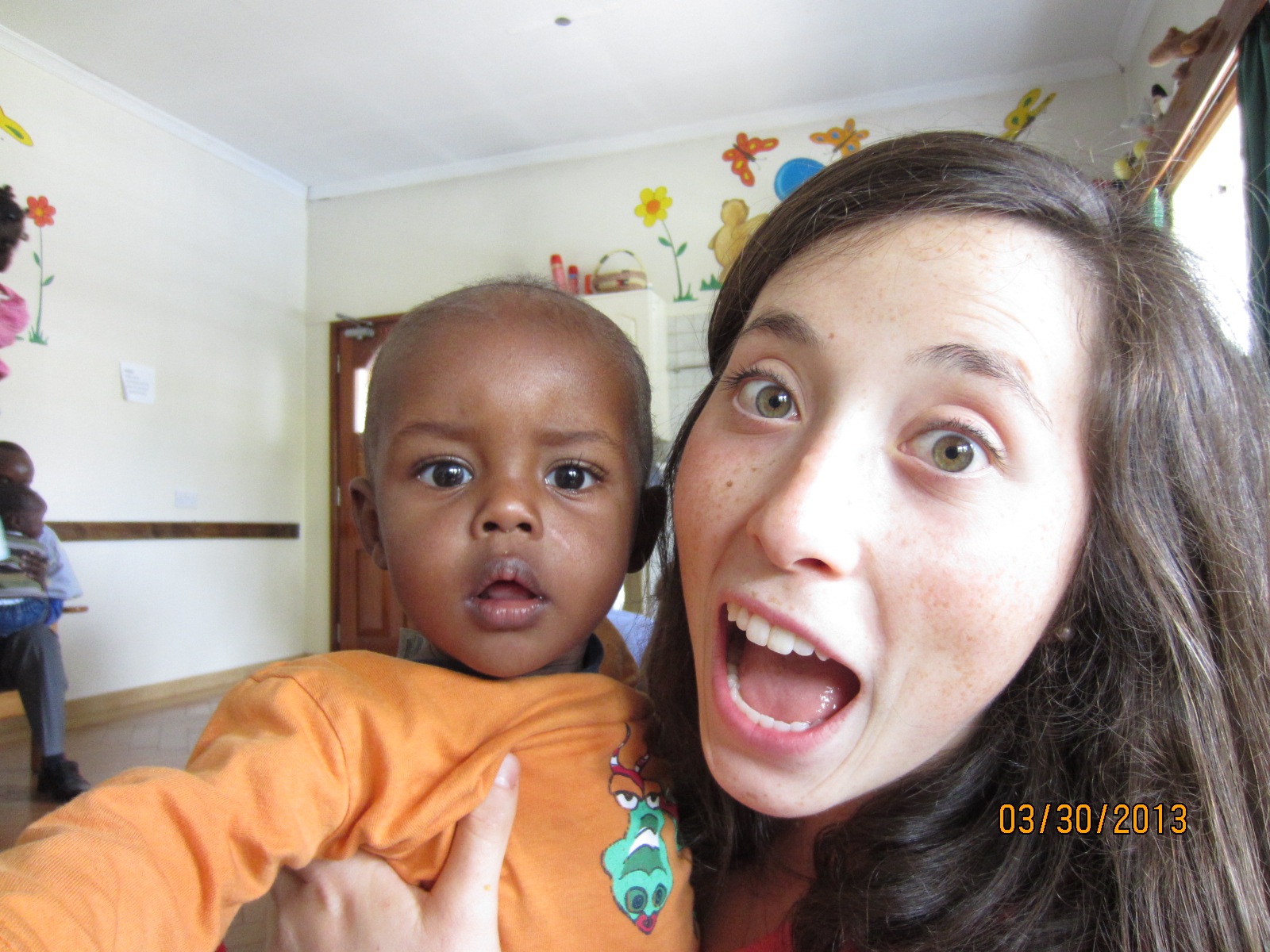
Today was perhaps the best day of all. Wairimu took a group of us to the New Life Home Trust in Nairobi. It is an orphanage for abandoned babies 0-3 months old. They are taken in by the home and raised until they are old enough to be tested for HIV. Those babies who test negative for the disease are put up for adoption, while the others are treated with ARVs until they are healthy enough to be adopted. The center welcomes volunteers and encourages them to play with the babies and toddlers. That's right. We were welcomed with open arms and instructed to play with any and all babies in the center.  It was like being a kid in a candy store except that the children might have been even more excited to see us than we were to see them (if that's even possible).  It was utter bliss and certainly an afternoon to remember. I shall return very very soon.


Peace, Love, and JOSEPH!

Our day concluded with take-out Indian food delivered straight to the compound from our favorite restaurant. We sat in sweatpants, listening to the rainstorm outside, and dined on curry and naan. 

All of that food wasn't for us
(I'm a foodie but not a gluttonous ogre) 

 Homemade nacho crew

 The biggest piece of naan Julia has ever seen

While classes are always hard to wake up for in the morning, the fun weekends that I've had in Nairobi keep me motivated to push through to the end of the week.

Tomorrow afternoon we leave for Amboseli where we'll spend a week going on safari and living amongst the Maasai.  I hope to indulge you with even more interesting stories when I return. Thanks for reading up until this point.  I realize now that my initial idea for a photo blog might have gone astray. 

Until next time...

Kwaheri ya kuonana!

Tuesday, March 19, 2013

Tanz(insane)ia


Hamjambo! I’m back from my two weeks of Tanzanian adventures. That’s right Mom—I wasn’t forced into an arranged marriage with my rural homestay brother, never to be seen again (not to say that there wasn’t a little chemistry between Humphrey and me).  This component was by far my favorite thus far.  Here’s why:

We arrived at Dorobo Safari Tours headquarters the first day, which is just outside of Arusha.  Our two incredibly handsome tour guides, Mika and Joshua, greeted us.  I would classify Mika as the dreaded mountain man type who loves to rock climb and run barefoot through the woods (obviously his favorite book is Born to Run, which I might add, I totally predicted).  Joshua, on the other hand, was more of the funny, sensitive cutie—total charmer but sadly not Jewish and not from the North American continent.

Joshua (right) and Mika (left)

The day before we departed for our safari, we played soccer with a local secondary school.  Keep in mind I haven’t played soccer since way back in middle school.  That being said, when am I going to play a game of soccer in Tanzania ever again?  Everything was going great during the first half.  Our team was winning, there was a crowd of locals watching us, and I managed to hold down the fort on my side of the field.  Obviously I got cocky once I realized I wasn’t completely sucking and that’s when things went downhill.  The ball was headed my way and I made a grand photo-worthy gesture to kick the ball downfield.  Well, I missed the ball entirely and instead directly kicked the ground.  I may or may not have broken my nubb in the process.  I’ve never broken a toe before, so I don’t quite know how that would feel…more specifically half a toe.  Either way, there’s no official way to heal a broken toe other than to let it heal itself…so I suppose that’s what I did.

After a couple of days in Arusha, we left for Tarangire National Park to spend two days on safari. YAY TOURISM! Along the way we came across a number of wild animals.  Most notable were two lions resting under a tree.  At first we were just excited to see the kings of the jungle in person.  However, as time passed we realized that a herd of zebras was heading to a waterhole just beyond the tree.  I know what you’re thinking. Wow Emma, you saw two lions wait patiently under a tree as a herd of unsuspecting zebras went to drink some water, and then the lions proceeded to pounce on the lone zebra at the back of the pack and tear it to shreds, completely dismantling it and immediately becoming the coolest, most primitive thing you’ve ever seen in your entire life! Wrong! Unfortunately the lions were young, inexperienced hunters who came across as lazy when they made a poor attempt to attack the pack of zebras.  All of the zebras easily escaped and lived to see another day as the lions went back to their comfy spot under the shaded tree.

And now for a section I like to call “Animals of the Savannah: They’re Just Like Us”

They Lazily Roll Around


They Can’t Wait for Snack Time


They Love to Splash Around


They Go to the Bathroom


They’re Always Procreating


After two long days of safari, I’m pretty sure I can identify every single bird known to man thanks to the expert bird watchers leading our tour.  Simon, my Maasai bestie, could literally identify any bird on our game drive with a quick check into his binoculars.

What’s that? A Lilac-Breasted European Roller? Psh, yeah, I knew that.

Simon also sported a Washington Nationals shirt for a few days.  When I excitedly yelled “SIMON! YOU’RE A NATS FAN?!”, he looked at me with the most puzzled of expressions. “Simon, you like the Nationals?” “What?” “They’re from Washington, D.C.” “Huh?” “BASEBALL!” “Oh, yes!”

…he’s never seen a baseball game in his entire life. A student on one of their previous tours gave him the shirt as a gift.  Peter, another staff member and safari truck driver extraordinaire also rocked a Nats tee. He too had no idea what the logo on his shirt signified.

Simon (left) and Peter (right)

While most people were drooling over our tour guides, I grew very fond of the rest of the staff on our trip.  Not only did Simon and I become buds, but I had an entire crew of bros comprised of Peter, our esteemed driver, Loma, chef-of-the-year, and Gideon, assistant to chef-of-the-year. When I told them my name was Emma, they misinterpreted my name as Neema, which apparently means prosperity in Kiswahili.  It really wasn’t a problem. In fact, I was quite flattered.  What got me a bit TO’d was when our professor, Sinnary, thought it would be funny to pretend to misinterpret my name as Nyama! Nyama is Kiswahili for meat.  Not to worry, Sinnary gained his own nickname as well.

Introducing Jamba, the Sudanese diva. [Translation: Jamba=Fart] I’m so mature ;)

After leaving Tarangire, we headed to the Nou Forest to meet up with the Iraqw tribe, a community of pastoralists whose ancestors migrated to Tanzania from Ethiopia. We spent one day hiking to a waterfall and another visiting the Madunga Village where the Iraqw people live.  Their homes were made of sticks and held together by cow dung.  Each home was segmented off into separate rooms for humans and livestock.  Cows and goats needed to stay inside the home at night in order to avoid being eaten by wandering hyenas.  While we had an opportunity to interview the Iraqw about their culture, it was difficult because they speak their own unique language and very little Kiswahili.  Translating their answers to our questions was a bit of a quandary.

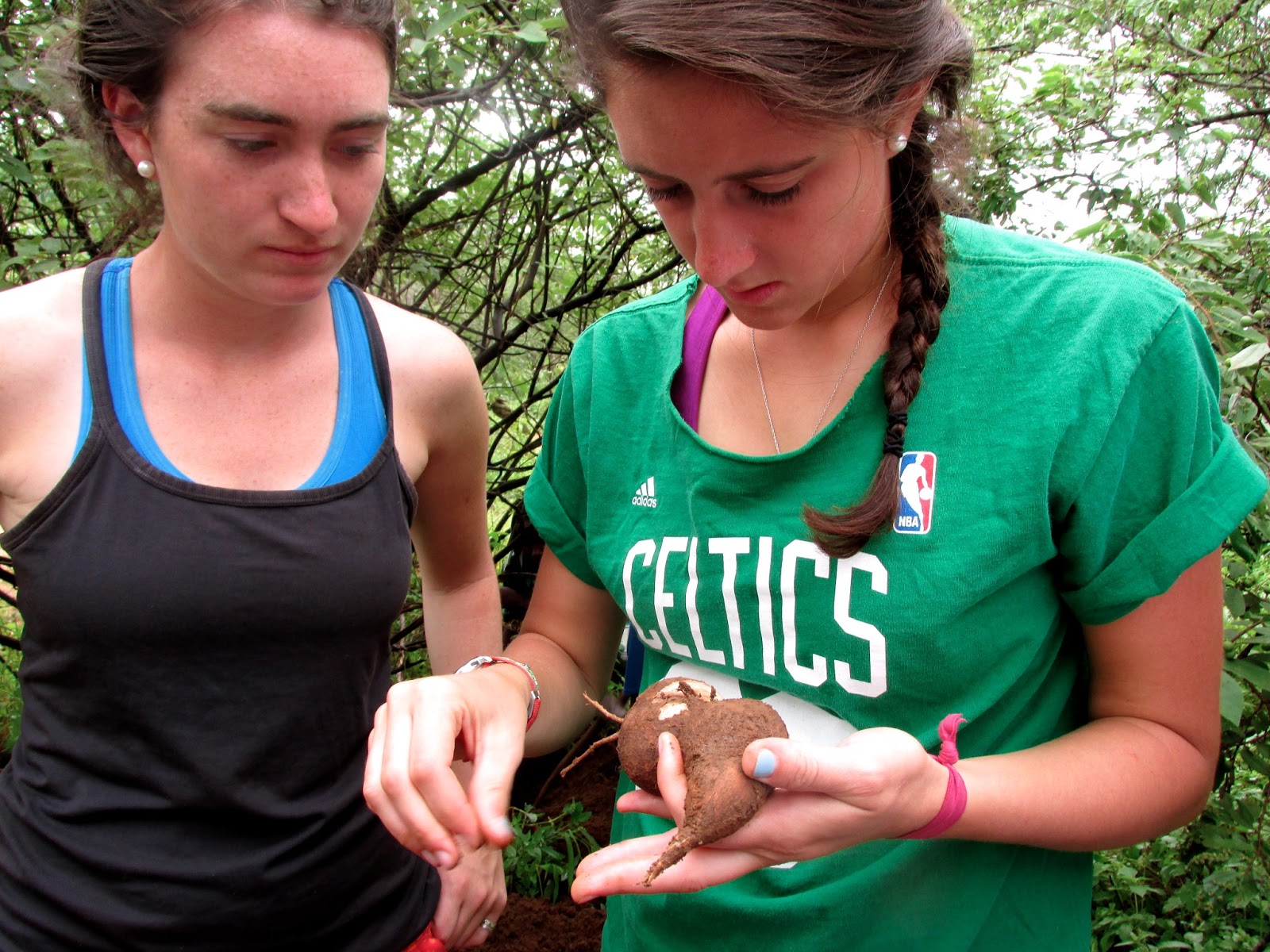
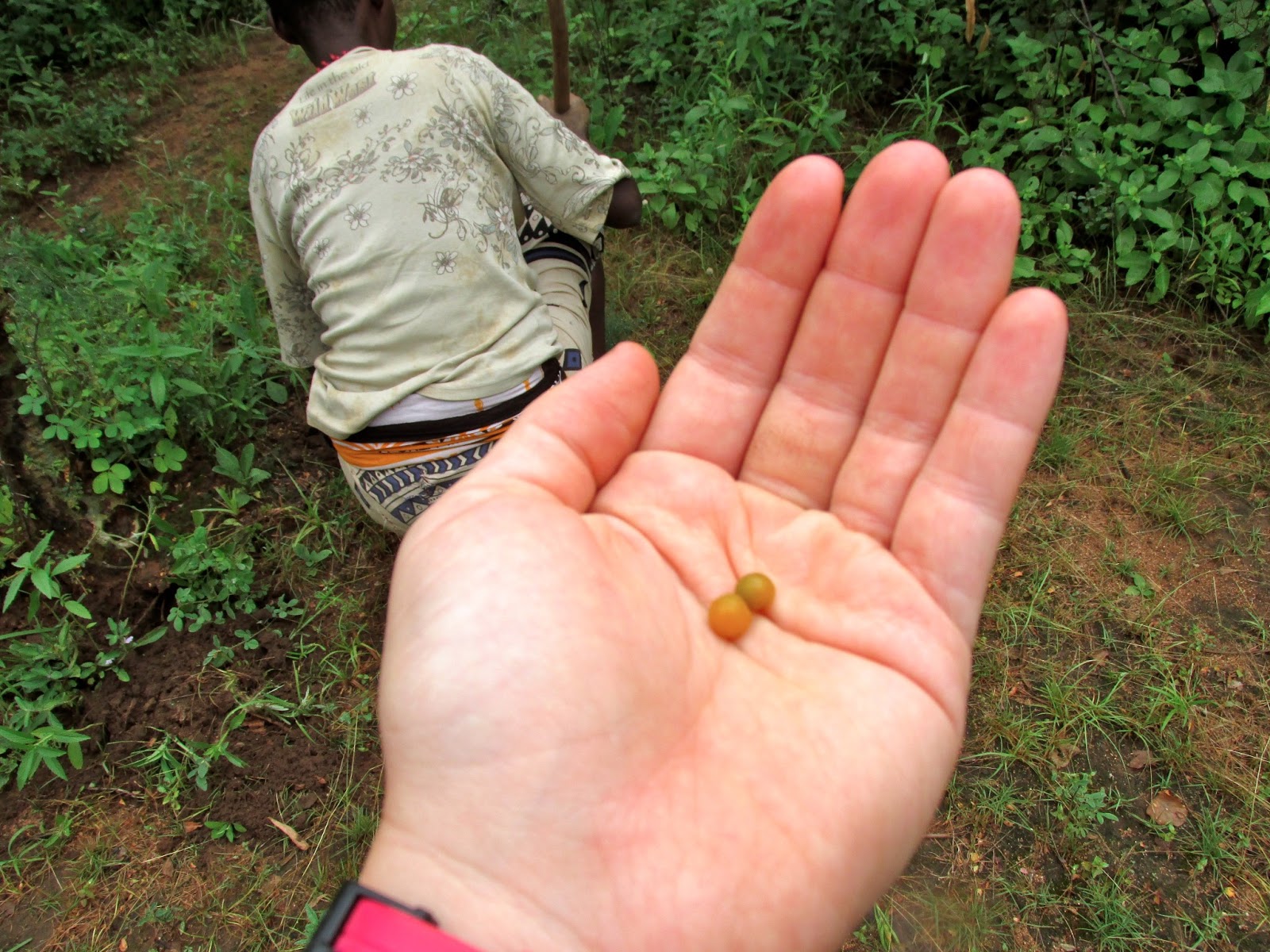
After leaving the Nou Forest, we headed to the Yaeda Valley to live amongst the Hadzabe, one of the last remaining hunter-gatherer communities in the entire world.  These people took “living off the land” to a whole new level.  Their homes are made from materials found around their camps, and they move their camps periodically in order to be near the best resources.  The women are in charge of digging for tubers (root vegetables) and gathering berries.  The men are responsible for hunting and harvesting honey.  Everything edible is prepared on the spot.  We went out digging for tubers one morning and started a fire right then and there to cook them up.  The entire village came along with us to reap the benefits of the harvest.  Everyone shares the food gathered by members of the community, no matter how young or old, big or small, male or female.  It was as close to an egalitarian society as I have ever witnessed or read about, and truly groundbreaking in my opinion.

Digging for tubers 

Chloe and Megan with a tuber 

Berries 

Chopping down beehives to gather honey 

Starting a fire to cook the tubers 

More fire-making

We had the chance to make arrows and go out hunting the following day.  My friends Abby, Julia, and I went out with Moshi (the best hunter in his tribe) to catch a giraffe.  Turns out killing (let alone finding) a giraffe is quite the challenge. We were lucky enough to catch a mongoose and hyrax. I had the honor of carrying the hyrax back to camp…after lugging it around for the duration of our 5-hour hunt.  While I did my best to hold it by its feet, as far away from my body as possible, at one point it swung a bit too close to my leg and smeared some of its postmortem blood across my thigh. It was not one of the most pleasurable moments of my life, but it was worth it once everyone saw me walking into camp with meat, thinking that I had killed it. JOKES! Moshi totally did all of the work.  Abby, Julia, and I chilled on a rock overlooking the incredible view while Moshi ran off and caught the bastard.  When he carried it back with two arrows stuck in it, we thought it was dead.  Then he placed it on the rock and it started running toward us.  Moshi proceeded to slam its head against the rock to kill it.  The entire process really induced my appetite, to say the least.

Moshi seeking out his prey 


Enjoying the view with Julia and Abby, waiting for Moshi to return with the goods 

Nothing like a good cig after a successful hunt

Other highlights included climbing a baobab tree (think rock climbing meets The Lion King) and dancing with the Hadzabe around a campfire.  The Hadzabe were compensated by our tour company in tobacco, salt, and marijuana.  That’s right, they were paid in weed…and they loved it.  They would smoke it all day if they could.  In fact, Mika had to ration it out to them each day because otherwise they would smoke the entire two-week supply in one sitting.  As Joshua put it, who wouldn’t love the Hadzabe?  They get high and hunt for the first part of the day, then spend the latter portion of the day getting high and socializing with each other.

Climbing the baobab tree

If it weren’t for all the bug bites continuously coating my body, I think I could be very content living with the Hadzabe for a while.  As a proud feminist, women have it good in their community.  They have just as much, if not more, power than their male counterparts because they produce 80% of the food that their entire village consumes. I loved the hunting. I loved the dancing. I loved their outlook on life.  They have everything they could ever need and don’t really care that the rest of the world lives a very different lifestyle from the one they do.

I absolutely loved Tanzania but it’s nice to be back in Nairobi sleeping in my own bed and taking a warm shower.  Heck, it’s just nice to bathe and not have to sleep in a tent.  I might do it for the Hadzabe though.

We’re in Nairobi taking classes for the next two weeks and then we’re off to Amboseli to hang out with the Maasai.  It’s incredible to think that I’m already halfway through this life changing experience. Maybe I’ll just never leave…

Tutaonana Baadaye!


P.S. Perhaps I skipped over a minor detail and forgot to mention the Kenyan Presidential election that occurred while we were away. Uhuru Kenyatta scored the win after some confusion over lost ballots and inaccurate counting.  Now Raila Odinga is appealing to the courts for a recount in order to salvage any chance he has of claiming the title. Hopefully he can maintain a peaceful approach and not rally his fans the way he did in the last election.  I’ll do my best to keep you posted. That being said, I feel very safe and Kenyans are hoping to maintain a peaceful atmosphere leading up to the presidential inauguration. 

Tuesday, February 26, 2013

That Time My Host Parents and I Finished a Box of Wine While Watching the Presidential Debate...


Well we’re back in Nairobi. Classes are classes and well, after feeling like I’ve been on a month-long vacation, it’s tough to get back in the swing of writing papers and reading scholarly articles.  Yes, I know what you’re thinking “Oh Emma, you’re so spoiled. All of us at WashU are swamped with work and you’re off playing with giraffes and writing reflective papers about your incredible experiences.” Well, I’ll have you know that I have THREE papers due Friday. Ok, so maybe I received these assignments over a week ago and I’ve had plenty of time to write them (but obviously haven’t cracked a book). Whatever. I’m definitely not using this blog post as an opportunity to procrastinate further.

My newest host family is GREAT. They live on a beautiful compound only a few miles from our compound in Karen. My father is a chemical engineer who went to university in Bulgaria and then England, and has travelled all over Europe. We love to chat about politics, which really means that I love having him teach me about politics, Kenyan history, and the upcoming election. Usually I’ll bring up some current events issue from the day (to seem as if I’m a big shot and know what I’m talking about), and then my father will proceed to clarify the issue and branch off into a more pressing matter that Kenyans actually care about. He’s smart. He’s funny. He’s awesome.

My host mother is a sassy businesswoman who now does HR consulting. She’s organized, straightforward, loves to go on long walks, and treats herself to massages every once in a while. She considers me her daughter and wants me to live at her home for the rest of my time in Kenya even though my homestay technically ends this Friday. I certainly would not be one to object. Their home is huge, equipped with Wi-Fi, gym equipment, a greenhouse, and 11 dogs (5 of which are 3-week old puppies).

I also have two younger siblings. My brother is 19 and commutes to university each day. He loves Lil Wayne and drives a Mercedes…in other words, he’s obviously too cool for me. My sister is 14 and attends an American-style school in our neighborhood. I’ve always wanted a sister and we’ve become fast friends. On Saturday we spent the entire afternoon watching the newest season of Glee, and on Sunday I taught her how to bake brownies from scratch.  Everyone in our family was very impressed that she hadn’t just added water to a Betty Crocker mix. 

We talk about hair a lot. I admire her long, braided extensions with strategically placed streaks of green and blue braids. She wishes she had my hair so that she could bleach it, dye it, cut it, and magically not damage it whatsoever. When she asked me why I don’t alter my hair dramatically, I told her that it’s because I don’t want to go bald before I’m 30.

Perhaps my favorite member of the family (although it’s hard to choose) is Ruth, our house help. She claims she doesn’t know any English, but of course she communicates that to me in English. In fact, all of our conversations have been in English, and they’ve actually gotten pretty heated. She’ll serve me a heaping pile of food and tell me that she’s going to help me gain 2 kilos before I leave. Then I proceed to cry out that I’m going to be sick from eating so much food. She plugs her ears and starts singing. I moan in agony…and shovel the food into my mouth. I can never win with her. Of course she only drinks tea all day and barely eats anything come dinnertime. It’s just not fair!

I’m the first Jew that Ruth has ever met, which has started some pretty interesting conversations. She’s baffled by the fact that I don’t claim Jesus as my savior and I don’t believe in heaven or hell. I can’t wait to see what she’ll do when I tell her that our services are on Saturdays! I’ve promised to go to church with her one weekend, and I told her that I will take her to the synagogue in Nairobi one day. She’s my pal and I’ll miss seeing her everyday once I leave.    

The way our classes are scheduled during the weeks when we’re at our urban homestay goes as follows: Monday through Thursday we have Kiswahili at 8:30 am followed by three 1.5 hour blocks of classes. The first block is followed by our lunch break. It feels like I’m back in middle school. I wake up at 6, get dressed, pack my lunch, quickly eat breakfast, and then get driven to the neighborhood Nakumatt (think Target but BIGGER) at 6:30, which acts as my makeshift bus stop.  A cab picks up my friend Chloe and me (whose host family lives in my neighborhood) and proceeds to drive us for two hours into Nairobi for class. Keep in mind that Nairobi is barely 30 minutes away without traffic. The roads are literally bumper-to-bumper getting to school. Add in the crazy matatus and you’ve got yourself one hell of a traffic jam. Last week we had some trouble with our taxi service.  Wairimu had systematically planned out a transportation schedule so that they would pick each of us up in the morning and return us home in the evening. They didn’t follow through so well on their end of the bargain, so being the boss that she is, Wairimu fired them! Now one of my mother’s personal cab drivers takes my friend and me to school. <3 John!

On Fridays we have Kiswahili followed by some afternoon activity. Last Friday we went to Kibera to experience what life is like in the slums. Just imagine 1 million people squeezed together in tiny shacks that together take up only 1 square mile of land. It’s unbelievable. There is no plumbing or sewage system, so people resort to using flying toilets. What are these thrifty contraptions? Well, because there are no toilets or latrines available, people put their waste into plastic bags. Keeping bags full of human waste in one’s home isn’t the most appealing idea, so people in Kibera toss these bags into whichever open areas they can find when no one is looking—hence the name “flying toilets”.  One of the main problems with this “solution” is that the bags are tossed near water pipes that bring drinking water into the slums. These old, rusty pipes often develop holes and leaks.  As a result, waste from the plastic bags seeps into the pipes and people end up drinking contaminated water because it is the only source available to them. That is why diarrhea and other gastrointestinal diseases are so rampant in Kibera. It’s a serious problem that NGOs are trying to resolve.

The main purpose of our trip to Kibera was to learn about different businesses and organizations that were started in the slums. We were split up into four different groups, and my group went to visit the SMOLFISH Project. This family business was started in 2001 as a hobby and later developed as a commercial venture in weaving kikoy fabrics and canvas. They have worked with various groups to teach individuals how to weave. What I found most interesting was that they train prison officers for about a year on how to make the fabric from start to finish. Then these officers go back to their prisons and teach inmates how to weave so that they can practice this trade once they are released.  We were given a brief introduction on how these kikoys are made, and I even got a chance to use the loom!  I regret to inform you that there is no photo evidence, only fond memories.

At one point the man leading our tour, who also happened to be the founder of the organization, left briefly to go “pick up something”. When he came back he was HOLDING A BABY. The cutest little 1 year old was resting in his arms with her head on his chest. Turns out he’s a father—who knew?! We asked him how many other children he has and he said he didn’t know.  Apparently he has multiple wives and multiple children, but he can’t keep count. When he saw the shock on our faces, he responded, “I don’t know how many children I have. Women come up to me. They say ‘this is your child’ and you either believe them or you don’t”. What a character! He told us that he would make each of us a special gift and deliver it to our compound later this week. We’ll see if he actually follows through with his promise.

Don’t worry Mom—I did get a chance to hold the baby and she didn’t cry. She actually fell asleep in my lap. Maybe I won’t be such a horrible mother after all.

Over the weekend I hung out with my host family. On Sunday my sister wasn’t feeling well so we stayed home and watched Glee as mentioned earlier. On Sunday, my brother drove us to the National Park and we went on a nature walk to see all of the animals. There were lions, tigers, but sadly no bears. There were, however baboons that roamed around freely. It was pretty cool interacting with baboons as if they were squirrels. Afterward, my sister and I met up with my mom at the local club for lunch. Then we went to visit my mother’s sisters who live only a few minutes away.

My host sister and I at the park

Last night was the second and final presidential debate before the general election on March 4th. I had planned on working on my papers all night, but who can pass up such a monumental event? This was only the second presidential debate in Kenyan history! So to celebrate this historic occasion, my father cracked open a box of wine. It was “special” wine from South Africa. I’m not sure whether the wine was for celebrating or maintaining our blood pressure while we watched the candidates deliver empty promises, but we had a good time. That box of wine may or may not have been finished by the time I went to bed. It was definitely one of the best nights I’ve had so far. My host parents and I had such a fun time laughing at candidates like Mohamed Abduba Dida, the teacher from who-knows-where who has never pursued a position in politics before. My mother cheered for Uhuru Kenyatta, “her man” as my father refers to him. My host father and I rooted for Peter Kenneth, the articulate, well-educated candidate from the Eagle Coalition whom everyone likes but refuses to vote for because it’s his first time running for president.

I am anxiously waiting to see what will happen next Monday. My prediction is that there will be a run-off because Kenyatta and Odinga are neck-in-neck. If that happens, my fingers are crossed that no violence will break out as tensions run high leading up to the second vote. Whatever the case, we will be safely residing in Tanzania starting this Saturday. My visa is good for 90 days, so if worst comes to worst I will not have to return to Kenya for some time.

To all of my friends and family: I am safe. I am happy. And I never want to leave Kenya. Someone will have to drag me out of here come May.

Cheers to a peaceful election!

Kwaheri ya kuonana!

Saturday, February 16, 2013

Mombasa: Working Hard, or Hardly Working?


After our first week of classes in Nairobi, we departed for a week on the coast.  For those of you interested in my academic endeavors this semester, I am studying Kiswahili, Gender in Traditional and Modern Kenya, and Biodiversity and Conservation in Kenya.  The Mombasa field component is typically scheduled toward the end of the semester as a spring break-ish trip.  However, because the coast (in particular Mombasa) is a swing region in the upcoming election, the program decided to move up our visit so as to avoid any potential post-election violence.

Everyone I talked to in Nairobi prior to our trip to Mombasa kept telling me how hot Mombasa is:

“Oh you’re going to Mombasa? It’s soooo hot.”

“So I’ve heard, but isn’t it also beautiful, full lush forests and gorgeous sunsets over the Indian Ocean?”

“Yeah that too, but it’s sooooooo hot.”

Little did I realize how hot Mombasa actually was!

Over the course of our ten-hour drive to the coast, the weather got progressively hotter and more humid.  There is no air-conditioning on our bus, only windows. Needless to say, those ladies who chose to rock the popular Hanes white v-neck disembarked the bus looking like participants in a wet t-shirt contest.  Ok, obviously this is a little exaggerated, but you get the idea.

We stayed at the Jumuia Resort and Conference Center: a quaint little getaway for tourists and business gatherings.  Luckily for us, we checked in during the middle of “no tourist season”.  We were the ONLY people at the resort…at least until Wednesday when there was a conference for Kenyans planning to work at the election polls in March.  There is a new electronic voting system being introduced for this election, so training programs have to be arraigned. 

Who wouldn’t want to work at the election polls this year?! You become more tech savvy and you get put up in a 4 star resort with all-you-can-eat meal service (until the food runs out), plush beds (equipped with bug nets that reek of body odor), daily pool access, and 24-hour beach access FO’ FREE! Sign me up!

Resort pool

Going into the Indian Ocean was an interesting experience to say the least.  Because the beach is public, beach boys are free to harass you into buying their products.  I’m not talking about the musically talented Beach Boys whose records your dad played on repeat during road trips when you were a kid. I’m talking about unemployed 20-somethings who try to sell you shells and starfish (which is ILLEGAL on the coast! You’re welcome, environmentally conscious friends), after which they invite you to visit their village.  A word of warning: inviting you to their village=soliciting you for sex. I’m sure your twelve-toed great-grandmother is very nice, but I’m not willing to risk my dignity to go meet her.

Indian Ocean

So I know it seems like I was on vacay for a week, but that’s because I was on vacay for a week. Ok, but I actually did do some work.  The academic component of this field trip involved interviewing members of the Mijikenda (the native tribal community whose religion is based on the presence of ancestral spirits) and the Swahili (the wealthier, Arab-influenced Muslims who migrated to the coast as a result of overseas trading).  We interviewed two panels, each representing one of the ethnic groups.  It was clear that the two groups had very different impressions of one another.  The Swahili people portrayed their relationship with the Mijikenda as a mutually respected acquaintanceship.  The Mijikendas, on the other hand described their relationship with the Swahilis in a less favorable light, where they had been subjugated and enslaved by the Swahilis.  The Swahilis were much wealthier and educated than the Mijikendas, so when they immigrated to the coast they used their good fortune to their benefit to take advantage of the indigenous people.

Other highlights included our visit to Fort Jesus. [I honestly couldn’t tell you a single thing about Fort Jesus because our tour guide was so terribly monotone and unenthusiastic.  Afterward he gave us a tour of Old Mombasa and narrated the outing with comments like “This is coconut tree”.  Newsflash: This is NOT the only coconut tree in Mombasa. Please provide more details.] 

Don't look too excited Mr. Tour guide Man

Not to worry, my patience was rewarded with free time to shop in the marketplace.  The old city reminded me of the Muslim quarter in Jerusalem.  The streets were packed with vendors begging us to come into their shops.  As soon as they noted my skin color, they doubled or even tripled the price of everything they had.  Luckily, Sue and Rob Trachman taught me the importance of good bargaining skills from a young age.  The following is a transcribed conversation that I had with one shop owner whom I encountered in Old Mombasa.  I was on the hunt for a traditional tribal mask carved out of wood:

Overly-eager-shop-owner-convinced-he’s-going-to-rip-me-off: [Pointing to a wooden serving spoon] “You like? I sell you for good price”

Me: “No thanks. I want that” [Points to painted mask, the size of a book cover]

Shop Owner: “How much you want to pay?”

[Note: Another saleswoman in the shop had tried to sell me the same mask about 5 minutes earlier for 650 shillings. When I told her that was a ridiculous price, she "generously" lowered it to 450 shillings before I rolled my eyes and walked away.] 

Me: “200 shillings”

SO: “Oh no. I give you for 400 shilling. That’s a very good price. Usually is 650”

Me: “Sir, mimi ni mwanafunzi” [Translation: Sir, I’m a student]
[Subtext: HELP ME I’M POOR (said in Kristen Wiig whiney voice)]

SO: “I buy this for 300 shillings. If I give to you for 200 shillings, I lose money”

Me: “Fine. Let’s come to a compromise. I want to pay 200, and you want me to pay 400. Let’s settle on 300 and call it a day.”

SO: “350”

Me: “Come on. We’re all friends here. You’re my friend aren’t you? C’mon. Let me have it for 300”

SO: [Raises an eyebrow]

Me: “Pleaseeee. Mimi ni mwanafunzi. Tafadhali.”

SO: “Ok fine. I give you for 300”

SUCCESS!

We also had the opportunity to visit a sacred forest owned by the Mijikenda.  The land has been preserved for centuries as an ode to their ancestors who founded the land.  The ancestral spirits are said to watch over the Mijikenda and provide healing powers.  Hence, there are witch doctors and the like within Mijikendan society.  Even nontraditional societies in Kenya have proven to be very patriarchal.  Mijikendan women are not allowed to participate in ritualistic sacrifices and practices, and only the elder men who have undergone years of training are allowed to attend.  Women simply have the “honor” of hauling the materials through the forest that will be used for the rituals. 

Ironically, I happened to be wearing pants with a very similar print to the kikoy that one of the elders was wearing. Obviously I had to get a picture with him. So readers, now it’s time for some audience participation. Who wore it better?


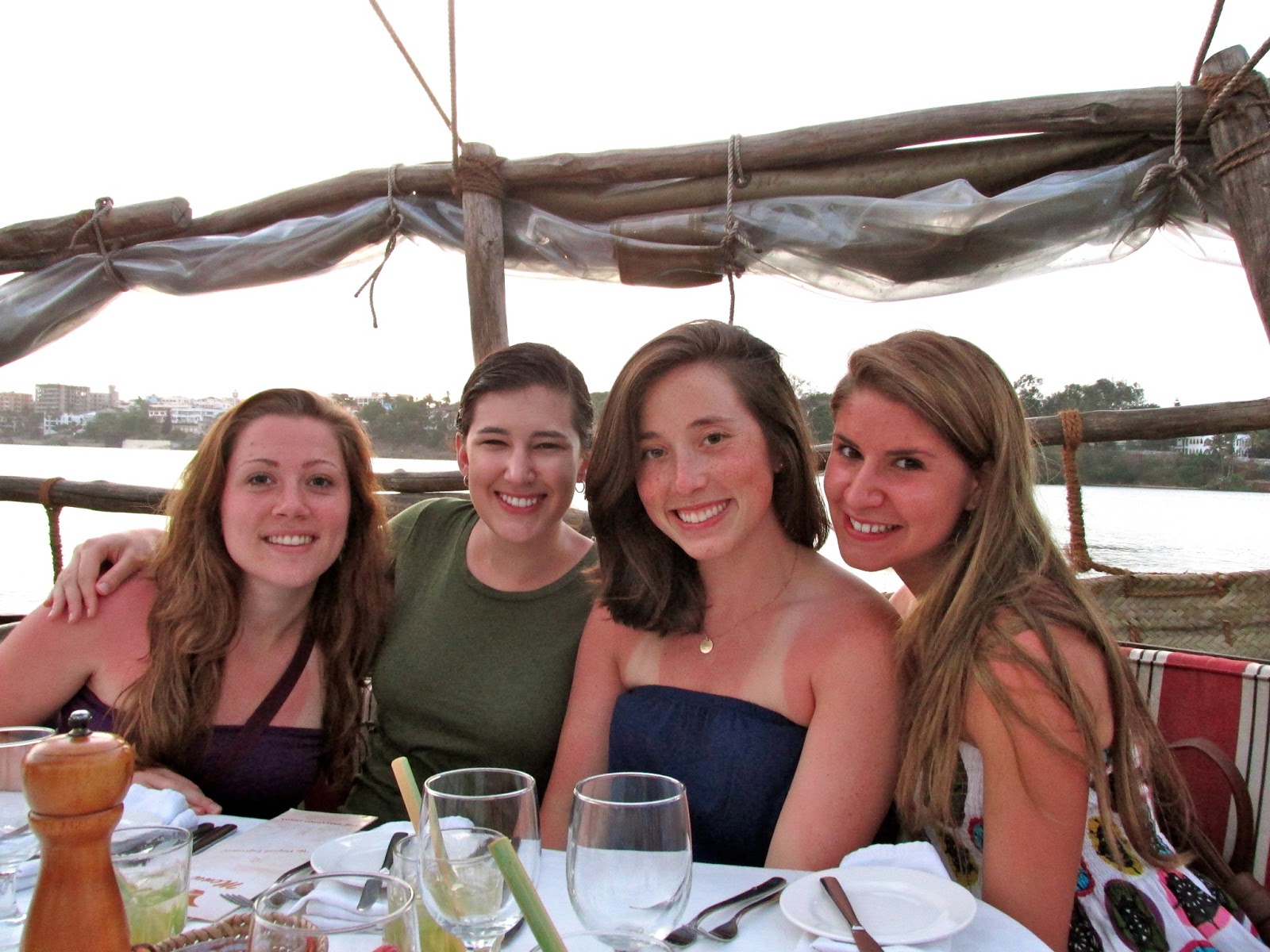
Our second to last night, we were treated to an evening dinner cruise on a channel just off the Indian Ocean.  It was FABULOUS! I enjoyed a four-course meal, which included seafood salad, tomato soup, grilled lobster, and chocolate cake, and a free drink all paid for by KSP (Kenya Semester Program).  It was glamorous, relaxing, and certainly not what one would expect for a semester abroad in a developing country.  Hence, please note the title of this post.

Life is rough

After completing group presentations the next day on what we had learned, we had the chance to visit Haller Park.  It’s a hot tourist spot for visitors hoping to see animals indigenous to Kenya.  I got the opportunity to feed giraffes, pet a giant tortoise, and watch crocodiles and hippos being fed. You might be thinking to yourself Oh ha ha, that’s funny. It must have been like the game Hungry Hungry Hippos. NO! A word of warning: hippos are not cute! They are the deadliest animals in the region and kill more tourists each year than any other animal in Africa.  So yeah, they don’t just feed on dime-size ping pong balls. The also enjoy petite, young Jewish girls looking for love and adventure in a foreign country.

Sun's out, tongues out 


Now we’re back home in Karen and tomorrow we meet our urban homestay families.  We’ll be living with them for two weeks while we take classes in Nairobi.  Afterward, we set off for Tanzania for another two weeks.  Rest assured readers, I will be posting once more before I leave for Tanzania.

Stay young! Stay fresh!
Peace, love, and 70 degree weather in Karen.

Kwaheri ya kuonana!